From Isolation to Intention: The Studio Redefining Dance in Los Angeles
Final Feature — Writing For Journalism
LOS ANGELES – On a weeknight in West Los Angeles, the sound of salsa music fills the red-painted walls of Soho Dance LA. Inside the spacious studio, dancers in patterned rhythms step and turn under bright overhead lights. The room hums with a collective pulse, long before anyone speaks, a rhythm formed by footsteps, community, and, of course, connection.
For many who fill the dance floor, Soho is more than a studio. It is a space where people from all communities come to breathe and rediscover themselves. One of those dancers is Cecile Munoz, an instructor whose journey with Latin dance began in an unexpected season of her life. Munoz said, "After my car accident, I couldn't walk properly. Dance became a way to prove to my doctor, 'I respect your diagnosis, but disrespect your prognosis." Munoz explained that when she stepped into the studio after her accident, she was not looking for movement but for parts of herself, which she evidently reclaimed.
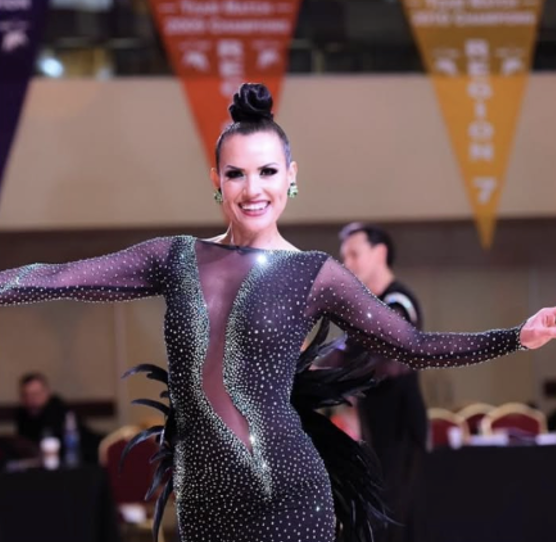
Her relationship to dance did not begin with her accident. It started with a small, simple gift. "My ex-husband gave me dance lessons as a gift," she said. "It ended up changing my life."
The lessons opened a door Munoz did not expect to walk through. But those lessons arrived at a moment when she was rebuilding both physically and emotionally.
"Dancing is how I brought myself back to life," she said. "It gave me a community, friends, a place to be happy and express myself again."
Munoz's story is striking, and it is evident that Soho Dance LA plays an essential role, one that began with the studio's owner. Founded by Raul Santiago, the studio was built with a practical and ambitious vision. Santiago says, "My vision was always to build a studio where the classes, the teaching, and the dance itself reflected exactly what I believed dance should be." The concept for Soho was shaped by the gaps Santiago saw in Los Angeles dance training. "Los Angeles needed better teachers, teachers who understand how to take someone from point A to point B."
The solution? Santiago decided that his studio would be centered on inviting everyone to the dance floor. Allowing room for everyday people that long for community. Santiago says, "LA is a 'teacher-heavy' scene," He explains. "Too many people are trying to dance for celebrities instead of focusing on education. I wanted to serve everyday civilians, not just professionals."
To give students tangible goals, Santiago introduced the Pro-am format at his studio, a competition structure in which professional dancers compete with amateur partners, allowing newcomers to experience the thrill of Latin and ballroom dance. He stated, "I wanted Pro-Ams so people could have real goals, something to work toward." Santiago explained, "Over time, the studio became something better than I could have imagined. It became a home."
This sense of home is apparent the moment classes begin. In one room, salsa rhythms fill the air as beginners learn the steps precisely.
Alongside that rhythm, advanced dancers complete intricate turn patterns. Each studio room opens different spaces, cultures and community. Munoz sees community firsthand, she says, "When I went from student to teacher, it felt like joining a big, beautiful community center," she explained. "There is absolutely no judgment here. You are not told you're ‘Too old.' Instead, you're embraced."
Munoz's classes are known for their grounded warmth and clarity, shaped not only by her ballet background, "I'm a ballet dancer by accident," she often says. But it is also because of her understanding of what community should look like in LA. "Aging in Los Angeles is hard," Munoz said. "Women over 40 often feel invisible. In my classes, you can be the best version of yourself and still feel completely welcome."
Her perspective extends beyond dance, often drawing parallels between the studio and other high-pressure environments. “In business and in male-dominated spaces, women can feel pushed aside," she said. "Latin dance can feel like that too, but it doesn't have to." She credits much of Soho's inclusive culture to Santiago. "The tone of kindness comes from the top," she said. "Raul sets that tone here."
Santiago sees connection as the core of partner dance. "Pattern dancing holds you accountable," he said. "One flawed human being dancing with another flawed human being, that's a real connection."
He believes the rising popularity of Latin dance reflects a cultural shift. "Latin dance is finally getting the recognition it deserves," he said. "It's not a trend, it's a culture. Young people are hungry for real connection, and Latin dance gives them that in five seconds."
Munoz added that the connection extends beyond the mechanics of each step. "There's something magical that happens the moment two people hold hands to dance," she said. "Humans are meant to be communal."
Soho, and its diversity, meet people where they are, mirroring LA's diversity. Some people are seasoned; others walk in not knowing the steps of Latin or Ballroom dance. Many arrive in Soho alone but quickly find themselves surrounded by community.
Jonathan Sanchez, a physics professor at UCLA, is one of them. He discovered his love for Latin dance during his undergraduate years and later found Soho through a simple search. "I literally just Googled 'dance studios near me,'" Sanchez said. "What brought me in was curiosity, but what kept me here was the community."
He explains that the studio offered a contrast in his academic life. "In physics, it's easy to stay in your own little bubble, physicists hanging out with physicists," he said. "Soho is a breather from that. It keeps you grounded."
Sanchez said the studio broadens the sense of opportunity. "Being here reminds me how big the world is," he said. "You meet people who look like you and people who don't. Seeing so many types of dancers shows you where you started and how much room you have to grow."
Snachez says one of his favorite parts is Soho's access. There are so many styles of dance here," he said. "I love the membership setup, come in whenever you want, practice, take a class, stay as long as you need. And honestly, it's the people. The community is made up of dancers from every background imaginable."
Latin dance gained widespread popularity in Los Angeles, and Santiago explained how cultural influences, such as Bad Bunny's salsa album, expanded its reach. Santiago envisions his studios' future that is "bigger and better, international, even," with an infrastructure that elevates every student's journey. "If someone walks in with a dream," he said, "we should have the structure to take them all the way."
He adds that, for him, growth must always stay rooted in intention. "A healthy studio starts with leadership," Santiago said.
"If I show up with discipline and kindness, the teachers follow, and so do the students. You can't demand respect; you create an environment where respect grows naturally."
Both Santiago and Munoz believe the rise of dance is not just trend-driven but human-driven. "Dancing is becoming a necessity in people's lives. it's the connection we all desperately want,” says Munoz.
Santiago echoed this statement with, "People think, 'I'm not Latin, so I can't dance.' I tell them: your location has nothing to do with learning how to dance. It's not ethnicity, it's work ethic."
In a world increasingly shaped by isolation and screens, Munoz sees dance as restorative. Technology isolates us. Dance brings us together; Latin dance is so wide and welcoming. If you can walk, you can dance."
Munoz often references thinkers who study the importance of community. "Arthur Brooks talks about how the most sought-after class at Harvard is the one about community and human connection," she said. "Scott Galloway says isolation is the most dangerous thing for our generation. Dance pushes against that."
Ultimately, Soho Dance LA is not just where dancers improve, but a studio where people step into belonging. Munoz has experienced this personally, alongside seeing others walk into that same light. "Soho holds your deepest joys and your deepest sorrows," she said. "It's challenge and positivity in the same room."
